

On a rural road in Iowa, Jaren Niewinski was a mile and a half from home when flames burst out from under the dash.
It was the middle of October, and the wagon had been sitting for a while, so Jaren had decided to take it for a cruise.
"I went to the car wash, cleaned it off, and made a loop from town to town. As I was coming back, I decided to give it a little spirited acceleration," he said. "Then, boom, the car fell on its face."
The engine was still running, and the oil pressure looked good, so at first he planned to nurse the car home.
Then he noticed a faint glow under the dashboard.
"It was a matter of 30 seconds from the moment it popped until I realized the car was actually on fire," he said. "Flames came up from the dashboard right next to my hand on the steering wheel."
Originally, Jaren's wagon was never supposed to be a high-horsepower drag machine.
Years earlier, he'd bought the stripped-out front-wheel-drive K-car, with no engine or transmission, for $100. His original plan was to turn it into a winter beater to throw his tools in and drive to work.
But then he realized the little wagon shared the same basic platform as the turbo Dodge Daytonas he loved, and he started seeing the possibilities.
One part led to another, and before long, the $100 beater had become a turbocharged sleeper.
"It's ugly," Jaren admitted with a laugh. "It's just ugly."
But that was part of the fun. At drag-and-drive events, people would laugh when the so-called "Woody" rolled up to the line.
"Everybody's got something to say about it, or laugh or giggle," Jaren said. "And then it lays down an 11-second quarter-mile pass."
That changed the conversation.
The "Woody" quickly became a fan favorite at events. "The cameras love it," Jaren said.
But that night, with flames coming from under the dash, his ugly little sleeper was in danger.
Jaren pulled over in front of the Long Grove Fire Department, but no one was inside the building at that moment.
"In the car, I had a standard dry chemical fire extinguisher," Jaren said. "I pulled the pin and started unloading it under the hood. Another guy pulled up, grabbed an extinguisher out of his truck, and sprayed it beneath the dashboard."
But even after unloading both tanks, the car was still burning.
Dry chemical extinguishers work best when the agent can directly reach the source of the fire, which can be difficult in tight spaces like this.
Within minutes, local firefighters responded and managed to knock down the fire.
"The firefighter that put it out, he knew the car. A lot of the people in town know the car, they see it every day," Jaren said.
The wagon survived, but then the long cleanup began. Where the dry chemical had been sprayed, Jaren saw rust spots on his formerly rust-free car.

"I threw the carpet out, and I noticed that any bare metal spots on the floor had started flash rusting," Jaren said. "Even the freeze plugs on the back of the motor, all the paint's flaked off and they're orange with rust. I feel like the dry chemical caused more damage to metal surfaces than the actual fire did."
As Jaren's experience shows, different kinds of fire extinguishers are suited for different situations.
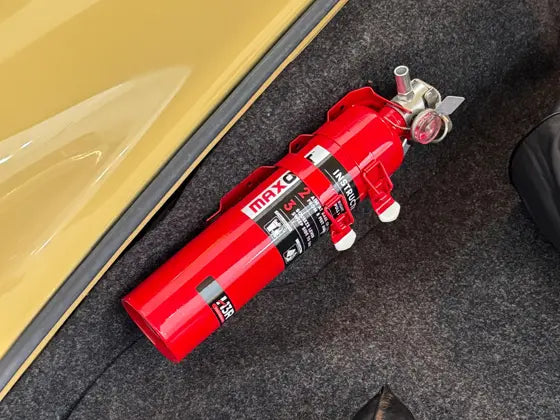
Dry chemical extinguishers, including H3R Performance MaxOut, offer strong, cost-effective protection for garages, trailers, campsites, and other less-sensitive areas. But in a vehicle, dry chemical residue can be difficult to remove completely, especially from tight spaces, bare metal, wiring, and hard-to-reach components.
Clean agent extinguishers, like HalGuard PRO, are designed to fight flammable liquid and electrical fires without leaving behind the kind of residue Jaren had to clean up.
Facing the aftermath of the fire, Jaren wondered if this was the end of an era.
Then the Shelby Dodge Auto Club rallied around him.
"They said, don't give up on it, man," Jaren said.
Members sent him encouragement and even gave him parts: new instruments, a period-correct Alpine stereo, and more. They wouldn't let him pay for anything; they told him to just put it in the car and get it going again.
"We have an annual convention every year, somewhere different in the country, and it's gotten to where it becomes like a family reunion," Jaren said. "These guys I've known over the years, they've become more than just buddies. Many of them I'll call brothers."
After months of hard work and support, the car was back on the road better than ever, and headed to the Shelby Dodge Auto Club convention. There, Jaren’s fellow members voted to give the wagon the Spirit of SDAC award, recognition that nearly brought him to tears.

H3R Performance was proud to support the club by donating a clean agent extinguisher and merchandise for the event.
For Jaren, the H3R extinguisher represents more than just a prize. It’s a tool every car person can use, and a reminder that not every extinguisher is meant for the same job. The right one could save someone else from the same overwhelming cleanup and heartache he faced.
Now he keeps a clean agent H3R Performance extinguisher mounted in his wagon at all times.
"Hopefully, I'll never have to use it," Jaren said. "But at least now I know there's a better way."
"Carry a fire extinguisher in your car at all times. But have the right one."
— Jaren Niewinski
Carry the Right Extinguisher for Your Car
MaxOut dry chemical extinguishers deliver strong, affordable protection for areas where residue and cleanup are less of a concern.
HalGuard PRO clean agent extinguishers fight fires without leaving residue behind. That's a critical advantage inside a vehicle, where dry chemical residue can damage the engine, wiring, electronics, and hard-to-replace parts.
Many auto enthusiasts carry both: HalGuard PRO for the vehicle, and MaxOut for a garage, trailer, campsite, or brush fire.
If you need to use your H3R extinguisher in a real fire emergency, our Emergency Replacement Guarantee helps keep you protected.
| GET PROTECTED |