

The explosion echoed from the top end of the track. Forty yards away, Dave saw the flames.
When Dave Steward goes drag racing, he's not just racing a car. He's honoring a legacy.
His father competed in NHRA Modified Eliminator back in the 1960s and '70s. Eight years ago, Dave built a tribute to that history: a 1968 Chevrolet Camaro in the same color, the same paint scheme, even the same decals his dad ran decades ago.
It's not just a race car. It's family.
Dave races with a stick-shift group called the Ozark Mountain Super Shifters, an association of drivers who prefer old-school manual transmissions over modern automation.
Hand-shifted gears. Pure driver skill.

Images by Dan Ricks - NostalgiaDragWorld.com
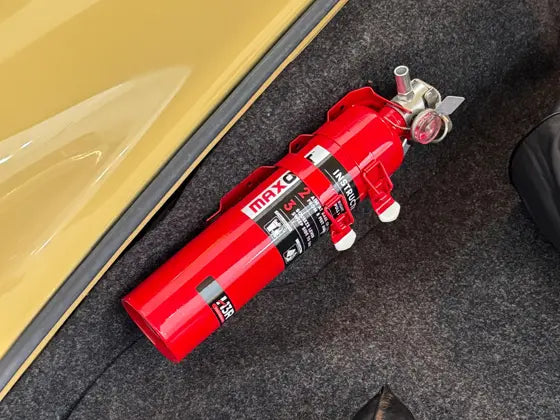
Carrying a fire extinguisher at these events isn't required, but Dave recommends it to everyone.
"Engines and gasoline are highly combustible. At a drag strip, there's always a chance something could catch fire," he told us. "And you never know if you're going to be the first person on the scene."
That decision to carry an extinguisher paid off at a summertime track event.
Dave was in the pits, past the finish line, when he heard an explosion at the top end of the track.
Forty yards away, flames erupted from an open-engine Altered drag car.
Dave grabbed his clean agent H3R extinguisher and sprinted toward the car as it rolled to a stop.
As with everything at a drag strip, seconds matter.
The fire crew was still mobilizing, but Dave was already there.
"When the fire is small, that's when you want to get to it," Dave said. "The quicker you can get it out, the less damage there is."
He pulled the pin, aimed at the flames, and put out the fire before the emergency crew arrived.
The driver was understandably shaken, but extremely thankful.
Racers often spend thousands of dollars, sometimes tens of thousands, building a single engine.
Nobody wants to save a car from a fire only to coat it in corrosive dry chemical powder that can harm wiring, electronics, and expensive components.
"When I saw that H3R clean agent extinguishers are safe for engines, that's what intrigued me the most," Dave said. "To spend a little more money to not hurt the engine? That was a no-brainer."
Even after stopping the fire, there was still enough clean agent left in the extinguisher to put out another fire at a different track event a month later.
The Ozark Mountain Super Shifters pride themselves on doing things the old-school way. But when it comes to protecting a precision engine, modern clean agent technology just makes sense.
When you've invested time, money, and heart into a machine, the goal isn't just to stop the fire.
It's to protect what really matters. For this generation and the next.
"We're spending thousands and thousands of dollars on these engines. We don't want to ruin them with a regular fire extinguisher. That's why I highly recommend H3R clean agent extinguishers."
— Dave Steward
Put Out the Fire Without Ruining the Engine
On the track or on the road, a clean agent extinguisher can stop the fire without coating your engine in damaging powder.
Get a clean agent fire extinguisher backed by our Emergency Replacement Guarantee.
| GET PROTECTED |